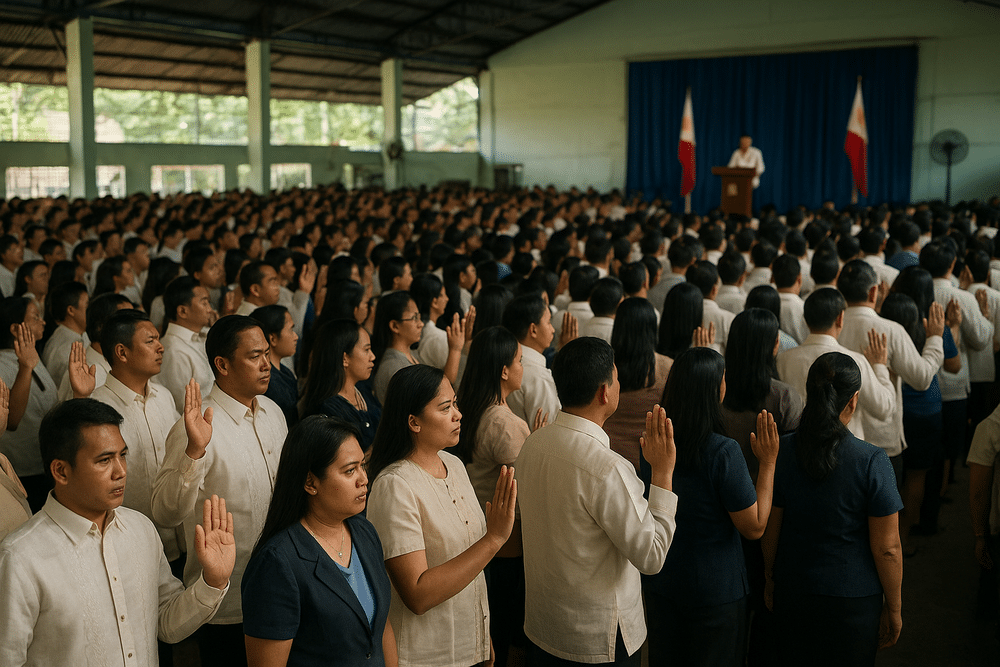
DAVAO REGION — A total of 2,649 public school teachers in the Davao Region have been promoted under the Department of Education’s Expanded Career Progression (ECP) program, marking one of the largest single-region advancement efforts in the agency’s ongoing push to elevate the teaching profession.
The promotions were formalized in a ceremonial oath-taking on March 6, 2026, at Nabunturan National Comprehensive High School in Davao de Oro, led by Education Secretary Sonny Angara. The event formed part of DepEd’s broader target to promote 100,000 teachers nationwide within the current fiscal year, aligned with its Five-Point Reform Agenda focused on strengthening the education workforce.
Promotions Span 11 Localities
The 2,649 newly promoted educators came from across 11 divisions in the Davao Region, reflecting a broad geographic reach:
456 from Davao Oriental
391 from Davao del Norte
358 from Panabo City
344 from Davao de Oro
283 from Island Garden City of Samal (IGACOS)
237 from Mati City
195 from Digos City
172 from Davao City
123 from Davao del Sur
69 from Tagum City
21 from Davao Occidental
The scale of the promotions underscores the government’s attempt to build stronger career pathways for teachers in public schools, particularly in regions serving large student populations.
A Reform Agenda Focused on Workforce Growth
DepEd’s Expanded Career Progression program seeks to offer clearer and more accessible advancement tracks for teachers, allowing them to move up in rank without necessarily leaving classroom instruction. The initiative complements earlier reforms, including professional development through Learning Action Cells and enhanced training under the National Educators Academy of the Philippines.
Speaking during the ceremony, Secretary Angara emphasized the role of local collaboration in supporting educators.
“Nagpapasalamat tayo dahil malinaw nating nakikita ang matibay na suporta ng ating mga education champions dito sa Davao Region, at patuloy na nagkakaisa at nagtutulungan ang ating field offices at local government units upang matiyak na mabibigyan ng sapat at makabuluhang suporta ang ating mga guro at mag-aaral.”
He noted that cooperation between field offices and local government units remains central to sustaining reforms designed to improve both teacher welfare and student outcomes.
New Division Office Signals Institutional Investment
The promotion rites coincided with the blessing of the new Schools Division Office (SDO) in Davao de Oro, a facility that supports 7,615 teaching personnel and 739 non-teaching staff across 456 schools. These institutions collectively serve 204,682 students.
The new office building stands as a physical counterpart to the policy reforms — brick and mortar reflecting bureaucratic change. Education officials say improved administrative infrastructure can streamline services for schools spread across geographically diverse areas.
What It Means for Classrooms
For families in the Davao Region, the promotions carry implications beyond titles and salary grades. Public schools remain the backbone of basic education for many households, particularly those with limited means. Strengthening teacher morale and retention may directly affect classroom stability and instructional quality.
Teacher career progression has historically faced hurdles, including strict qualification requirements, access to training, and limited mentoring opportunities. While DepEd has not linked these issues directly to the current batch of promotions, broader reforms aim to address systemic barriers that can stall professional growth.
By elevating thousands of educators at once, the agency signals an effort to make advancement less of a bottleneck and more of a structured ladder.
Toward a National Target of 100,000
The Davao Region promotions represent a fraction of DepEd’s ambitious 100,000-teacher promotion target for the fiscal year. Achieving that figure would mark one of the largest coordinated career advancement efforts in the history of the country’s public school system.
In a system as vast as the Philippines’ public education network, change often moves incrementally. But on a single morning in Nabunturan, 2,649 teachers stepped forward together — a visible sign of a national reform effort unfolding one region at a time.