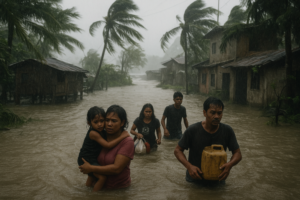
Siargao Faces Flood, Landslide Threat as Rains Hit
Siargao Island and several parts of northeastern Mindanao were placed under a Heavy Rainfall Warning early Saturday after state weather bureau PAGASA flagged persistent downpours triggered by a prevailing shear line, raising the risk of flooding and landslides across vulnerable communities.
Issued at 5:00 a.m., Heavy Rainfall Warning No. 1 covered Dinagat Islands and Surigao del Norte, including Siargao Island. The agency placed these areas under a Yellow Warning, meaning “FLOODING is Possible in Low-Lying Areas and LANDSLIDE in mountainous areas.”
The advisory underscored the immediate threat to coastal villages, hillside communities, and key transport routes linking remote barangays to provincial centers.
Shear Line Triggers Intense Downpours
PAGASA attributed the heavy rains to a shear line—a weather system formed when cold and warm air masses converge, often producing sustained rainfall. Unlike a defined tropical cyclone, a shear line can stretch across regions like a seam in the sky, releasing steady precipitation over wide areas.
By early morning, moderate to heavy rains were already affecting several municipalities in:
- Surigao del Norte, including Surigao City, Claver, Gigaquit, Tubod, Mainit, Alegria, Bacuag, Malimono, Placer, Sison, Tagana-an, and San Francisco;
- Surigao del Sur, including Tandag City, Cantilan, Carrascal, Madrid, Lanuza, Carmen, and Cortes; and
- Agusan del Norte, including Cabadbaran City, Santiago, Jabonga, and Kitcharao.
PAGASA warned that the rains “may persist within 2-3 hours and may affect nearby areas,” expanding the potential impact zone as the system evolved.
More Provinces on Alert for Rainfall Spillover
Light to moderate rains were forecast to spread to neighboring provinces, including:
- Camiguin;
- Additional towns in Surigao del Sur such as Bislig City, Lianga, Barobo, Hinatuan, and Lingig;
- More areas in Agusan del Norte, including Butuan City, Nasipit, Buenavista, and Tubay;
- Parts of Maguindanao del Sur and South Cotabato;
- Portions of Misamis Oriental and Lanao del Norte.
The cascading forecasts reflected how shear lines can shift rainfall patterns quickly, soaking provinces in succession rather than all at once.
Communities Brace for Flooding and Landslides
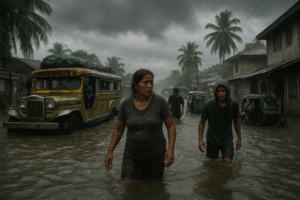
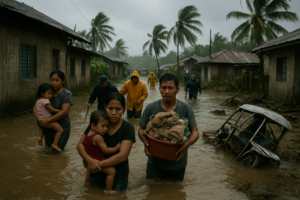
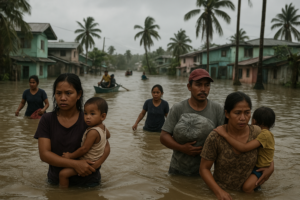
For residents of Siargao—a low-lying island fringed by coastal villages and backed by forested hills—the warning carried immediate consequences. Floodwaters can pool quickly in flat barangays, while saturated slopes increase the danger of landslides along narrow interior roads.
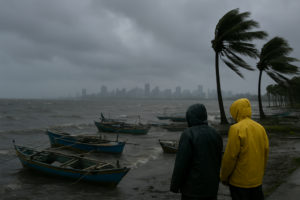
Fishing boats often stay docked during sustained downpours, disrupting daily livelihoods. Farmers in coconut and rice-growing areas face waterlogged fields. In upland communities, muddy roads can halt transport of goods to market centers such as Surigao City and Dapa.
Even short bursts of heavy rain can strain drainage systems, forcing classes or local transport services to suspend operations temporarily. Informal riverbank settlements are particularly exposed when waterways swell.
Local Authorities Told to Monitor Closely
PAGASA said it had advised “public and the Disaster Risk Reduction and Management Offices concerned to monitor the weather condition,” signaling the need for heightened vigilance at the municipal and provincial levels.
Under the Philippine Disaster Risk Reduction and Management Act of 2010 (Republic Act No. 10121), local governments are mandated to activate preparedness protocols once weather advisories signal potential hazards.
The next update was scheduled for 8:00 a.m., giving authorities a narrow window to assess conditions and prepare for possible evacuations should the rainfall intensify.
Warning Eventually Lifted, Weather Remains Unsettled
By 9:00 a.m. on 26 February 2026, PAGASA’s regional forecast indicated that no active Heavy Rainfall Warning remained in effect for Mindanao. The outlook shifted to partly cloudy to cloudy skies with scattered rain showers or thunderstorms, temperatures ranging from 24°C to 32°C, and light to moderate winds from the northeast to east.
While conditions eased, PAGASA’s broader climate outlook noted that La Niña remains present, with a 60 percent chance of transitioning to neutral conditions in the coming months. Such transitions can still bring unpredictable bursts of rainfall, particularly across eastern Mindanao.
For now, the skies over Siargao and neighboring provinces may have lightened. But in a region where sea and mountain meet, communities know that a few hours of steady rain can redraw the landscape—turning calm waterways into torrents and quiet slopes into potential hazards.
The episode serves as a reminder that in Mindanao’s eastern corridor, weather warnings are not abstract bulletins but practical alerts—signals for fishermen, farmers, students, and local officials to act swiftly before water and gravity take their course.