PPA Denies Congestion amid Metro Manila Port Pressure
The Philippine Ports Authority (PPA) has firmly rejected claims of congestion at Metro Manila’s two main container terminals, saying yard utilization levels remain “healthy” despite pressure from peak volumes and industry complaints of trucking bottlenecks.
As of February 12, 2026, yard utilization at Manila South Harbor stood at 72.97 percent, while the Manila International Container Terminal (MICT) registered 84.16 percent. Reefer or refrigerated yard space — critical for food and pharmaceutical imports — reached 85.32 percent at MICT and 70.66 percent at South Harbor.
Despite these elevated figures, PPA General Manager Jay Santiago insisted there was no cause for alarm.
“There is no port congestion. Let’s not create a scenario which will create undue concern to the public that there will be a hike in prices resulting from port congestion,” Santiago said. He added that “yard utilization at the Manila ports remains healthy even if utilization is above optimum. Higher utilization does not mean congestion. Cargo processing remains consistent and free flowing.”
High Utilization, Different Definitions
The dispute centers less on raw numbers than on definitions. The PPA maintains that cargo continues to move steadily in and out of the ports, arguing that high yard use reflects efficiency rather than gridlock. In Santiago’s words, strong throughput “shows that the Manila terminals are getting more efficient in handling cargoes.”
In 2025, the country’s ports handled 308.5 million metric tons of cargo, a 6.6 percent increase from the previous year. Container traffic surpassed 8 million twenty-foot equivalent units (TEUs), including 5.55 million TEUs in foreign trade and nearly 3 million TEUs in domestic cargo. Ship calls climbed to 664,817, and roll-on/roll-off vehicle traffic rose 13.3 percent to 12.81 million vehicles.
MICT alone posted a record 3 million TEUs in throughput last year.
From the PPA’s perspective, these figures signal a port system operating near capacity but not beyond it — akin to a busy highway that continues to move traffic without a standstill.
But logistics and customs brokers see the situation differently.
Truck Deadlock and Empty Container Pressure
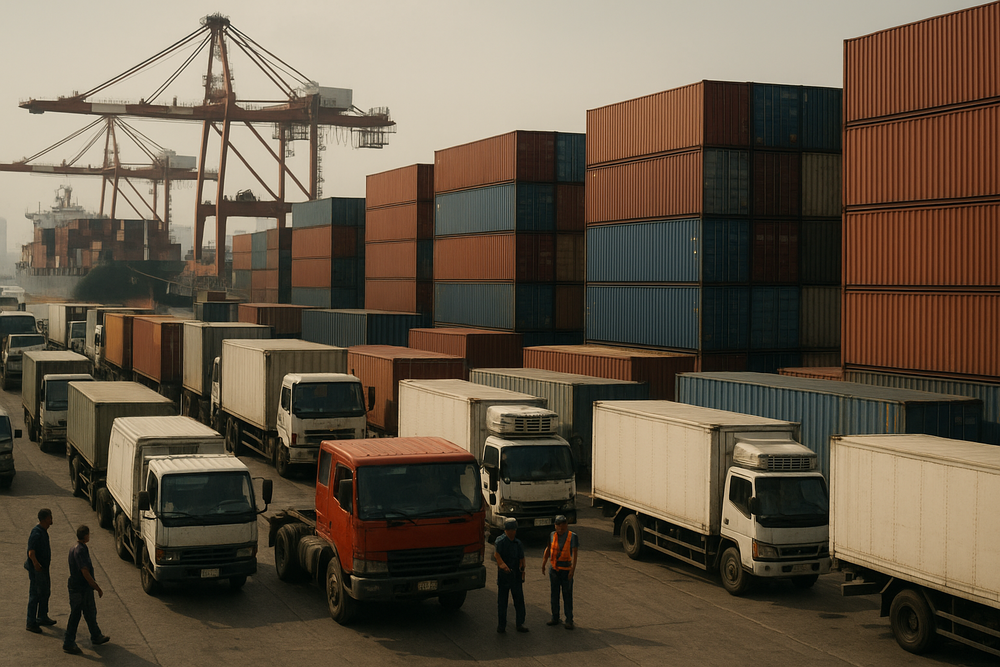
The Philippine Chamber of Customs Brokers Inc. (PCCBI) warned of operational strain at ground level. In a statement, the group said its members and the broader logistics community “are grappling with a severe truck deadlock caused by the limited capacity of empty container yards, which prevents the timely return of empties and, in turn, stalls the withdrawal of laden containers from terminals.”
The issue does not lie solely within the terminal gates. Members of the Alliance of Container Yard Operators of the Philippines reported that facilities in Metro Manila are operating at 85 to 90 percent capacity, while yards in Bulacan and Valenzuela remain at a more moderate 45 to 50 percent.
The imbalance means trucks returning empty containers often queue for limited slots within the capital, slowing the turnaround cycle. When empties cannot be returned promptly, drivers cannot collect new loaded containers. The result, operators say, is a chain reaction that reduces trucking capacity and increases delivery times.
The Philippine Multimodal Transport and Logistics Association Inc. described the situation as somewhat “alarming,” urging government to take the lead in addressing the concern.
International Container Terminal Services, Inc. (ICTSI), which operates MICT, also acknowledged a “serious lack of truck capacity in the supply chain at the moment,” partly attributing it to the “unfortunate timing of holidays” that resulted in “very limited withdrawal of import containers.”
Reefer Traffic and Food Supply at Stake
The debate carries wider implications because MICT handles the overwhelming majority of refrigerated cargo entering Metro Manila.
As of the latest data, MICT accounted for 6,560 TEUs of refrigerated containers, compared with just 343 TEUs at Manila South Harbor — roughly 95 percent of temperature-sensitive cargo passing through the capital’s main ports.
With reefer yard utilization at 85.32 percent, any slowdown could ripple through the supply chain for imported meat, seafood, dairy products and medicines. Businesses fear that prolonged delays would inflate cold storage and trucking costs, eventually affecting consumer prices.
The PPA, however, sought to calm such concerns. “Port charges remain constant and can’t be arbitrarily adjusted or increased,” Santiago said, emphasizing that fee structures are regulated and not subject to sudden hikes.
Policy Levers and Long-Term Solutions
Industry groups have called for stricter enforcement of PPA Administrative Order No. 02-2019, which requires cleared import cargoes remaining in ports for more than 30 days to be transferred out immediately. The PCCBI has also proposed reducing the allowable storage period for empty containers from 90 days to 60 days, arguing that this would compel shipping lines to clear overstaying equipment faster.
Meanwhile, a 16 percent adjustment in cargo handling tariffs approved under a 2024 memorandum circular continues to frame cost discussions between terminal operators and cargo owners.
For regulators, the priority is maintaining throughput. “These 2025 results reflect our commitment to a more efficient, reliable, and interconnected port system that supports economic growth across the archipelago,” Santiago said. “As we enter 2026, we remain focused on delivering solid results that translate to safer, more reliable, and more accessible port service and national development.”
A System Under Strain, but Still Moving
The gulf between official assurances and industry anxiety underscores a broader tension in Metro Manila’s logistics chain. The ports are not at a standstill. Ships continue to berth. Containers continue to move. Throughput numbers continue to climb.
Yet within that flow, pressure points have emerged — especially in the handling of empty containers and truck availability. Whether those strains amount to congestion or simply tight operations depends largely on whom one asks.
For now, the PPA maintains that the nation’s busiest gateways remain efficient and “free flowing.” Logistics operators, however, warn that without coordinated adjustments, today’s high utilization could harden into tomorrow’s bottleneck — with consequences extending from warehouse floors to household budgets.