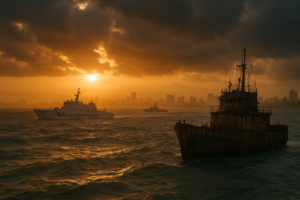
China Expands Military Reach, Raises Regional Tensions
China’s expanding military footprint is no longer confined to the contested waters of the South China Sea, Australian defence officials have warned, pointing to a pattern of assertive actions that now stretches across the Pacific and into the Indian Ocean—reaching waters near Australia and New Zealand.
The assessment, delivered in recent briefings by Australian officials, signals a broadening of Beijing’s strategic ambitions and raises fresh concerns about maritime security in one of the world’s most vital trading corridors. At its core is a rapidly growing Chinese navy, increasingly willing to project power far from its shores.
An Expanding Arc of Military Activity
Australian defence officials say China’s behaviour reflects a shift from regional posturing to sustained, long-range operations. The People’s Liberation Army (PLA) Navy has accelerated the deployment of ships and submarines beyond the South China Sea, establishing a presence in the East China Sea, the South Pacific, and the Indian Ocean.
In a striking example, a PLA naval task group completed a full circumnavigation of Australia earlier this year, conducting live-fire exercises in waters between Australia and New Zealand. While such movements may be lawful in international waters, Australian officials described them as deliberately demonstrative.
“China’s behavior, as a whole, is becoming more assertive and as China’s military capability power has grown, it’s become more confident in how it uses that military capability in the region,” one Australian official said.
Another senior official stressed that the trend is not limited to one maritime zone. “While we see that the People’s Liberation Army are operating in the South China Sea, it is also occurring simply into the Southwest Pacific… and also out into the Indian Ocean,” the official said.
The South China Sea as the Testing Ground
Despite this geographic expansion, the South China Sea remains the focal point of China’s confrontational strategy. Beijing continues to claim more than 90 per cent of the sea under its so‑called nine-dash line—a claim invalidated by a landmark 2016 ruling of the Permanent Court of Arbitration.
Australian officials have warned that China could resume or expand land reclamation in disputed areas, a tactic previously used to transform reefs into fortified artificial islands. One assessment noted that Beijing faces few immediate constraints.
“It’s very possible… They can just keep doing the things they want which is certifying their control over increasingly excessive territorial claims,” an Australian official said.
Direct Confrontations With the Philippines
The consequences of this approach are felt most sharply by the Philippines, whose coast guard and fishermen face regular encounters with Chinese ships inside the country’s 200-nautical-mile exclusive economic zone (EEZ).
In recent years, confrontations have escalated from shadowing and blocking to outright collisions. Chinese coast guard vessels have rammed Philippine patrol boats during routine missions, including a widely reported incident in September 2024 involving a vessel carrying foreign journalists.
According to a 2025 Pentagon assessment, Chinese coast guard and maritime militia units routinely engage in ramming, water-cannoning, and close-quarter manoeuvres in both the South and East China Seas, while PLA forces maintain concentrations west of Luzon.
An independent expert summarised the strategy starkly: “The issue is not merely fishing, but the systematic denial of other states’ lawful use of their exclusive economic zones through China’s claim over nearly all waters within the nine-dash line.”
Ripple Effects on Livelihoods and Trade
For coastal communities in the Philippines, the dispute is not an abstraction of geopolitics but a daily economic threat. Roughly 1.6 million Filipino fisherfolk depend on access to waters now routinely patrolled—or blocked—by Chinese vessels. Disruptions to fishing grounds have knock-on effects on seafood supply and prices across the archipelago.
More broadly, heightened military activity along critical sea lanes raises concerns about regional trade. Any sustained disruption in these waters could affect shipment costs for essentials such as fuel, food, and manufactured goods—a vulnerability felt even in distant economies, including those of Europe’s Mediterranean states that rely heavily on Asian maritime trade.
Legal Rulings and Strategic Responses
The legal framework governing these disputes is unambiguous. The 2016 arbitral ruling, binding under the United Nations Convention on the Law of the Sea, affirmed the Philippines’ sovereign rights within its EEZ and rejected China’s historic claims. Beijing, however, continues to disregard the decision.
In response, Australia and its partners have placed growing emphasis on multilateral deterrence. Joint patrols, expanded defence cooperation, and freedom-of-navigation operations are increasingly seen as the only viable check on unilateral actions.
Australian officials argue that collective presence acts as a stabilising counterweight—less a provocation than a reminder that international waters are governed by shared rules, not the preferences of the strongest navy.
A Regional Signal With Global Implications
From Canberra’s perspective, China’s far-reaching deployments are a signal to the entire Indo-Pacific that power projection is now central to Beijing’s foreign policy. The circumnavigation of Australia and live-fire drills near New Zealand were not isolated events but part of a broader pattern.
For smaller coastal states—and for trading nations far beyond Asia—the message is equally clear: disputes once seen as regional flashpoints now carry global economic and security implications. As one Australian assessment implied, the challenge is less about a single sea and more about whether established maritime law can still hold in an era of rising great‑power rivalry.