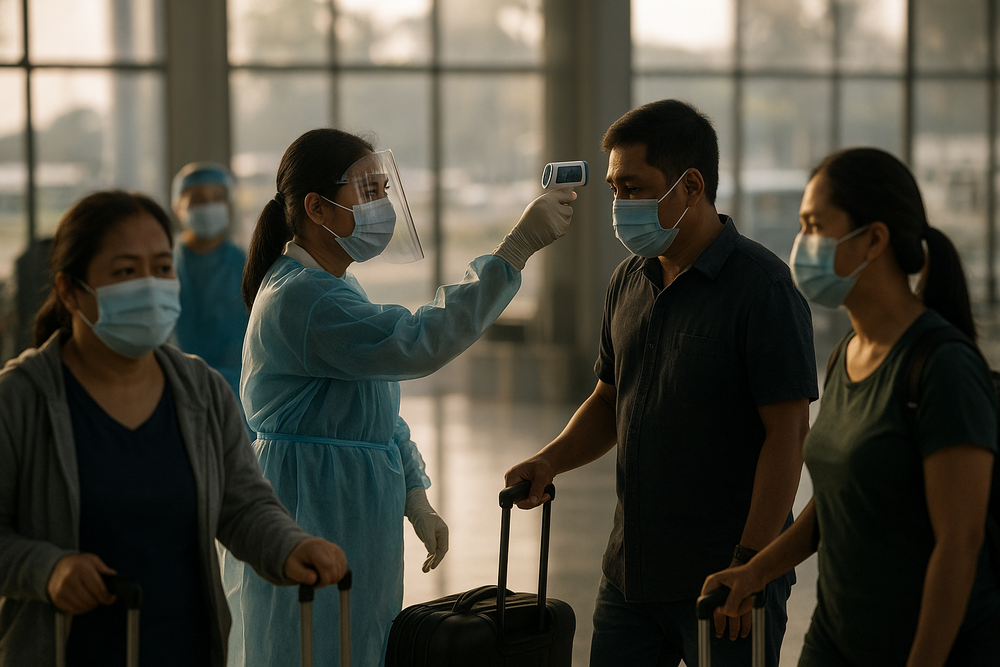
India has confirmed two cases of the deadly Nipah virus in the eastern state of West Bengal, prompting intensified health surveillance across parts of Asia, even as officials stress that the outbreak appears contained. While no infections have been recorded outside India, Thailand and Malaysia have stepped up airport screenings to guard against regional spread of a virus with one of the highest case-fatality rates known to modern medicine.
The Indian health ministry said both patients are healthcare workers who remain in intensive care. Since December, authorities have traced 196 contacts linked to the cases, all of whom have tested negative and shown no symptoms. “Speculative and incorrect figures regarding Nipah virus cases are being circulated,” the ministry said in a statement, confirming that the official count stood at two.
A Deadly but Contained Threat
Nipah virus is rare, but feared. According to the World Health Organization, it carries a fatality rate of between 40 and 75 per cent, far higher than that of Covid-19. The virus is zoonotic, jumping from animals to humans, most often through fruit bats that contaminate food sources such as date palm sap. Human-to-human transmission can occur through close contact with bodily fluids, particularly when patients are already showing symptoms.
Indian officials insist there is no cause for public panic. “Available data suggest that there is no need for the general public to be apprehensive about the safety of individuals and their family members,” the health ministry said, citing the absence of new cases beyond the two confirmed infections.
Regional Caution at Airports
Despite the limited scope of the outbreak, neighbouring countries have moved swiftly. Thailand has screened around 1,700 travellers arriving from West Bengal at major airports in Bangkok and Phuket. Thermal scanners, health declarations and isolation protocols are now in place for passengers deemed high-risk.
The country’s public health minister, Phatthana Phromphat, emphasised that preparedness rather than alarm was driving the response. “If there’s a suspected case at an airport, the person will be quarantined and the results of a relevant test will be known in eight hours,” he said.
Mr Phatthana also sought to calm fears of unchecked spread, noting a key difference from Covid-19. “The transmission of Nipah virus is not like that of Covid. Even though they may be asymptomatic, Covid‑infected people can transmit the virus. For Nipah, infected people will not transmit it as long as they do not have any symptoms.”
Malaysia has adopted similar precautions at its international entry points, while other Asian jurisdictions, including Taiwan and Nepal, have signalled tighter monitoring of arrivals from affected areas.
A Virus with a Regional History
Nipah is not new to South and Southeast Asia. The virus was first identified during outbreaks in Malaysia and Singapore in 1998 and 1999, linked to pig farms, infecting nearly 300 people and killing more than 100. West Bengal recorded its first outbreak in 2001, with further flare‑ups in 2007. In recent years, the southern Indian state of Kerala has seen repeated outbreaks, including cases as recently as July 2025.
Bangladesh continues to report sporadic cases almost every year, underlining the virus’s persistence in the region. Although no current cases have been detected in Southeast Asia beyond India, public health experts say history justifies vigilance.
What It Means Beyond Asia
For countries far from the epicentre, including Mediterranean states like Malta, the immediate risk remains minimal. Nipah is far less contagious than influenza or coronavirus, and there is no evidence of international transmission linked to the current cases. Still, the episode illustrates how quickly local outbreaks can prompt global ripples in an era of constant travel.
Health agencies worldwide continue to rely on awareness, early detection and isolation. There is no specific treatment or licensed vaccine for Nipah virus, making prevention the primary defence.
For now, Asia’s stepped‑up screenings resemble a firebreak rather than a full-scale emergency response—an attempt to contain a spark before it can spread. Whether those measures will remain sufficient depends on what happens next in West Bengal, where authorities say the situation is under control but under close watch.