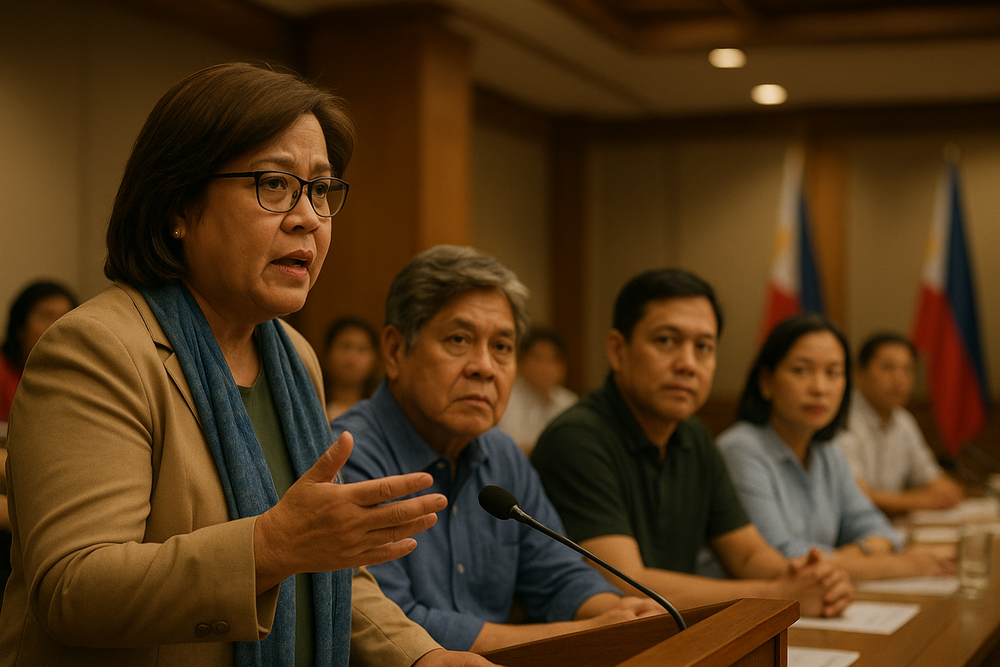
Manila — The Philippines’ Liberal Party (LP), one of Asia’s oldest political movements, reshaped its leadership on January 23, 2026, appointing former senator Francis “Kiko” Pangilinan as chair emeritus and human rights lawyer and lawmaker Leila de Lima as party chairperson, in a move aimed at consolidating the opposition ahead of the 2028 national elections.
The leadership changes were confirmed during the party’s National Executive Council and Officers (NECO) meeting, which also installed Erin Tañada as party president, formalising a transition that party officials say is designed to strengthen unity, sharpen ideology and rebuild grassroots reach after years of electoral setbacks.
A Symbolic and Strategic Reset
The appointments place two of the party’s most recognisable figures at its moral and organisational helm. Pangilinan, a former LP president and long-time reform advocate, assumes the largely symbolic role of chair emeritus, while de Lima, a former justice secretary who spent years in detention before returning to Congress, takes on the operationally significant post of chairperson.
Party leaders framed the changes as both a nod to history and a calculated step toward the future — anchoring the LP’s identity in its resistance to authoritarianism while preparing for the realities of modern electoral politics.
“Even if it is not the trend, we fought for truth and human rights. We did not back down,” Pangilinan told party members, recalling the LP’s confrontations with past dictatorships. “We did not submit to threats to dignity, life, and freedom.”
New Officers, Familiar Names
Alongside Pangilinan, de Lima and Tañada, the NECO meeting filled out the party’s top ranks with sitting and former lawmakers:
- Krisel Lagman, Albay representative, as executive vice president
- Alfonso Umali, Oriental Mindoro representative, as treasurer
- Kit Belmonte, former Quezon City representative, as secretary-general
Tañada’s confirmation as president ends a year-long period in which he served in an acting capacity following the death of veteran lawmaker and party leader Edcel Lagman in early 2025.
Positioning for 2028
The leadership shake-up comes as the LP seeks to reposition itself after losing national power in 2016 and enduring successive electoral defeats. Pangilinan made clear that the party’s focus has shifted decisively to building broad coalitions rather than reviving past formulas.
“Through the combined efforts of the broadest possible coalition, the 2028 elections — like the 2025 elections and beyond — are ours,” he said. “It is in our hands, in our united hands, to win.”
At the same time, party officials signalled caution about future alliances, saying it was “too early” to discuss cooperation with the administration of President Ferdinand Marcos Jr., whose family name is inextricably linked to the dictatorship the LP once opposed.
A Party Shaped by History
Founded on January 19, 1946, by post-war leaders Manuel Roxas, Elpidio Quirino and José Avelino, the LP is the Philippines’ second-oldest active political party, after the Nacionalista Party from which it split.
The party governed under four presidents — Roxas, Quirino, Diosdado Macapagal and, most recently, Benigno Aquino III — and paid a heavy price during the Martial Law years from 1972 to 1986, when many of its leaders were jailed, assassinated or forced into exile.
That legacy now underpins the LP’s renewed emphasis on anti-dynasty, anti-authoritarian and pro-democracy politics, themes Pangilinan reiterated during the meeting.
“The Liberal Party fought brutal dictatorship. It fought for the freedom to choose the nation’s leaders,” he said. “We did not submit to the challenges of the times.”
Limited Immediate Impact, Longer-Term Stakes
For ordinary Filipinos, the internal reorganisation carries no immediate effect on daily concerns such as prices, transport or public safety. Yet analysts note that opposition parties often act as political barometers, shaping debates that can later influence legislation and governance.
By elevating figures associated with civil liberties and institutional reform, the LP is signalling how it intends to frame future contests — presenting itself as a counterweight to strongman politics and entrenched political families.
Looking Ahead
The party remains a full member of regional and global liberal networks, including the Council of Asian Liberals and Democrats and Liberal International, ties it hopes will help rebuild credibility at home.
Whether the new leadership can translate symbolism into votes remains an open question. But with Pangilinan as elder statesman, de Lima as organisational leader and Tañada at the party’s operational centre, the LP is betting that clarity of purpose — forged by history and sharpened by defeat — can still matter in Philippine politics.