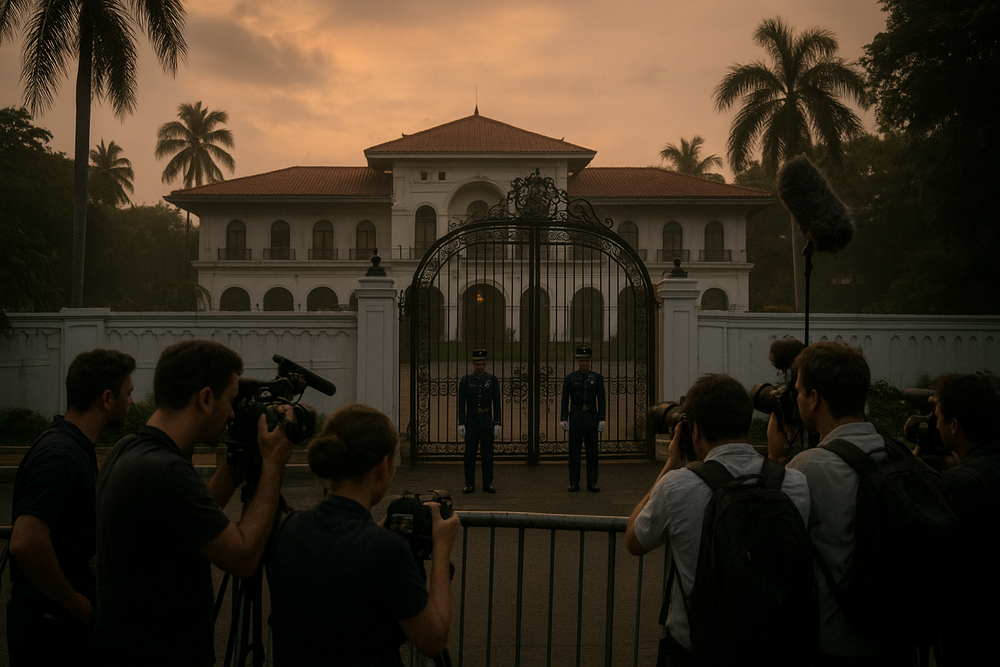
Claims circulating online that President Ferdinand “Bongbong” Marcos Jr. has waved off calls for his removal with a blunt warning have drawn attention in the Philippines and among overseas observers. Yet despite the sharp wording attached to the narrative, there is no verifiable public record of such a statement from the president or his office.
A Phrase in Search of a Source
The line, attributed broadly to Marcos in social media posts and political chatter, has not been corroborated by official transcripts, press briefings, or formal communications from Malacañang Palace. No authenticated speech, interview, or written statement contains the remark as presented, leaving its origins unclear.
This gap between circulation and confirmation matters. In Philippine politics, where rhetoric often travels faster than documentation, unsourced claims can quickly harden into assumed fact.
What Is Known — and What Is Not
What is known is limited and largely procedural. There is no active constitutional process underway to remove Marcos from office. No impeachment complaint has advanced in Congress, and no court action threatens his mandate. Calls for resignation, where they exist, remain confined to pockets of political dissent rather than formal legal channels.
What is not known is whether Marcos directly addressed such calls in the dismissive terms attributed to him. Without records from the Office of the President or reliable on-the-record reporting, the claim remains unsubstantiated.
The Resilience of the Presidency
The Philippine presidency is structurally insulated from casual attempts at removal. Like a reinforced structure built to withstand tremors, it requires specific constitutional triggers—not slogans—to shift power mid-term. Impeachment demands legislative action. Court rulings require cases grounded in law. Neither threshold has been met.
Against this backdrop, even sharp political rhetoric would carry limited immediate consequence.
Why the Narrative Persists
The persistence of the claim speaks less to documented events and more to political mood. Marcos remains a polarising figure, and narratives that suggest defiance or dismissal of critics resonate with supporters and opponents alike. In an environment saturated with commentary, ambiguity becomes fertile ground for projection.
A Reminder on Verifiability
For readers in Malta and beyond, the episode underscores a basic journalistic principle: assertions require evidence. Until official statements or reliable documentation surfaces, the idea that Marcos directly told his critics to temper their expectations belongs to the realm of political lore, not established fact.
In the absence of proof, the most accurate conclusion is also the simplest: despite the noise, the Philippine president’s position remains intact—and rumours, however confidently phrased, do not change constitutional realities.