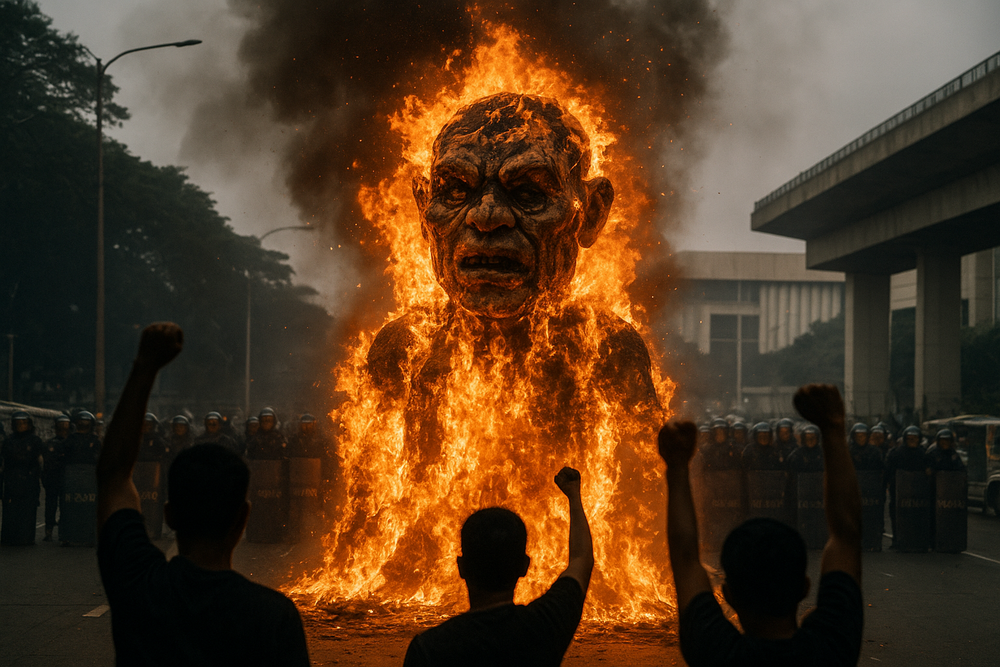
Every July, as the Philippine president delivers the State of the Nation Address (SONA inside a fortified complex in Quezon City, another ritual unfolds outside: a towering effigy, often grotesque and mechanical, is paraded before protesters and set ablaze. For more than half a century, this act of political theater has served as a visual shorthand for dissent — part spectacle, part anger, and part civic tradition.
Known simply as “effigy burning,” the practice has become a defining feature of SONA protests in the Philippines. Its roots stretch back to the turbulence of 1970, when students and workers took to the streets to denounce President Ferdinand Marcos Sr. What began as improvised symbolism has since evolved into an annual protest art form that reflects shifting political grievances, from corruption and U.S. influence to drug war killings and fractured political alliances.
Born in Crisis: 1970 and the First Quarter Storm
The first effigy associated with a SONA protest appeared on January 27, 1970, hours after President Marcos Sr. addressed Congress at the old Legislative Building, now the National Museum. Students affiliated with groups such as Kabataang Makabayan and the National Union of Students of the Philippines burned an image of Marcos and hurled a cardboard coffin toward police lines. The confrontation spilled into the night, leaving dozens injured and marking the start of what would be known as the First Quarter Storm.
“After noon, nagkaroon ng series ng protesta. Bumuhos ang tao sa lansangan. Yung mga kabataan libo-libo,” recalled Max Santiago of the Bagong Alyansang Makabayan (Bayan), the coalition that would later become synonymous with effigy protests. “Yung tinatawag na First Quarter Storm of 1970.”
Within days, unrest escalated. On January 30, protesters stormed Mendiola Bridge toward Malacañang Palace, setting a firetruck ablaze under gunfire from the Presidential Guard Battalion. By February 12, crowds estimated between 10,000 and 50,000 marched from Plaza Miranda to the U.S. Embassy, condemning Washington’s backing of Marcos. Effigy burning, though not yet formalized, had set a tone: dissent would be loud, visual, and confrontational.
From Paper Figures to Moving Machines
Over the decades, effigies transformed from crude papier-mâché figures into elaborate installations mounted on wheeled platforms. By the early 2000s, Bayan and its cultural collectives were producing animated effigies with spinning parts, trapdoors and puppetry — street theater designed not just to criticize but to draw commuters and cameras.
Notable examples include the “HolDAPer King” effigy burned during President Gloria Macapagal Arroyo’s 2004 SONA, a play on kidnapping allegations, and theatrical pieces staged in front of police barricades in 2014. In 2017, protesters unveiled “Rody’s Cube,” a rotating structure bearing images of President Rodrigo Duterte alongside Ferdinand Marcos Sr., Adolf Hitler and a snarling dog, a condemnation of the drug war and martial law in Mindanao.
Later that year, Bayan burned a “Trump fidget spinner” effigy during a separate protest, an image that rippled far beyond Manila when it appeared on American late-night television.
A Year Without Fire
For all its persistence, the ritual has not been uninterrupted. In 2016, the first year of Duterte’s presidency, no effigy was burned — the first such absence in 16 years. Instead, protesters mounted a six-panel mural titled “Portraits of Peace”, a move organizers said reflected cautious optimism.
The rally drew an estimated 30,000 protesters, making it one of the largest and most peaceful SONA demonstrations on record. Bayan secretary general Renato Reyes Jr. described it as “historic,” crediting the administration for respecting the right to assembly.
The pause proved temporary. By 2017, effigies returned, sharper and more incendiary as Duterte’s drug war and human rights record drew increasing scrutiny.
2024: Effigies in an Age of Fracture
The most recent iteration came on July 23, 2024, when protesters burned a massive black skeletal effigy during the SONA, evoking decay and internal collapse. Santiago said the imagery pointed to cracks within the ruling alliance.
“Pinapakita natin na wala na yung unity na tinatawag, campaign slogan siya,” he said, referring to the administration’s campaign rhetoric. He cited Vice President Sara Duterte’s absence from the address and her decision to declare herself designated survivor as signs of deepening division.
The Law, the Line, and the Police
Effigy burning occupies a protected but delicate space in Philippine law. The 1987 Constitution guarantees freedom of expression and peaceful assembly, while the Public Assembly Act of 1985 requires rally permits from local governments. There is no specific law banning effigies; police intervention is authorized only when gatherings turn violent or block major roads.
Supreme Court rulings, including Bayan v. Ermita (2006), have repeatedly affirmed these rights. Still, police maintain heavy deployments around the Batasang Pambansa complex, citing risks to public order. No official data exists on arrests or costs tied specifically to effigy protests, which fall under general crowd-control protocols.
The Commuter’s Burden and the Masa Message
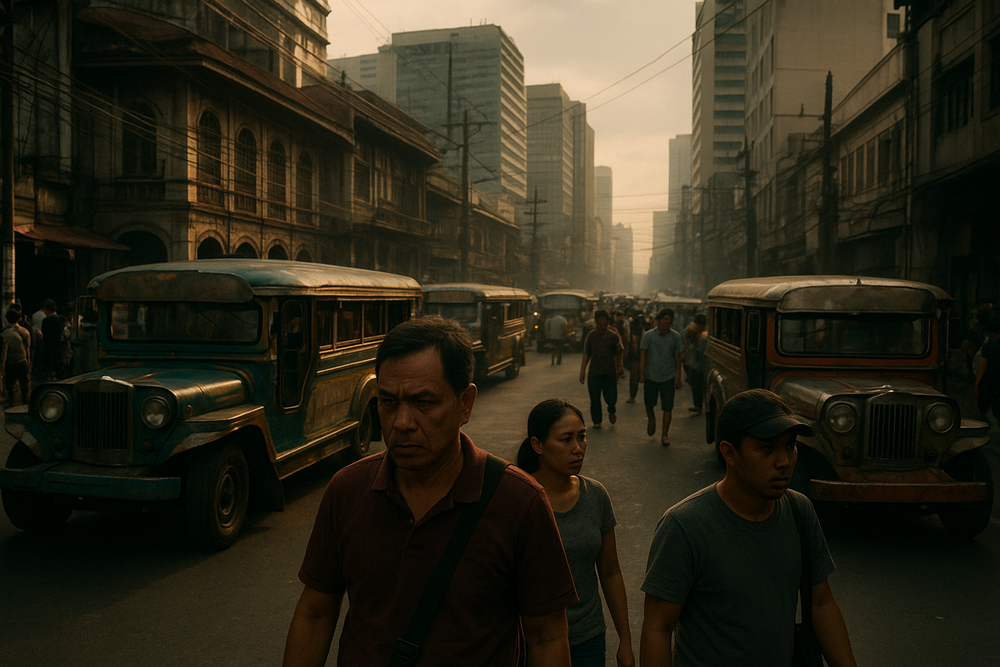
For residents of Metro Manila, the spectacle often comes with practical costs. Road closures along Commonwealth Avenue and Batasan Road snarl traffic, delaying jeepney drivers and office workers. In poorer neighborhoods near rally routes, memories of past clashes — particularly those of 1970 — still cast a shadow.
Yet organizers argue that the disruption mirrors the hardships they seek to highlight: stagnant wages, landlessness and the privatization of essential services. Effigies, they insist, translate abstract policy failures into images the public can grasp.
A Ritual That Refuses to Fade
Half a century on, burning an effigy remains one of the Philippines’ most distinctive forms of protest — a loud, combustible metaphor that flares once a year and then disappears in smoke. Its persistence reflects both a resilient protest culture and unresolved political tensions.
As long as the SONA projects power from behind barricades, it appears the flames outside will continue to answer, reminding leaders and onlookers alike that in Philippine politics, dissent is often not just spoken — it is set on fire.