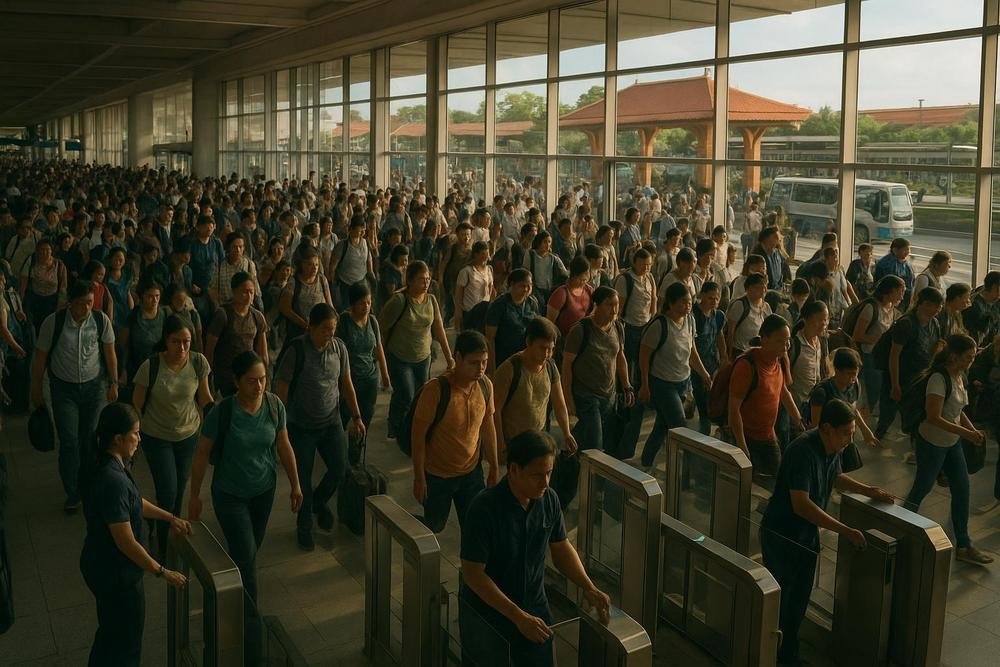
The Ninoy Aquino International Airport (NAIA) reached a historic milestone in 2025, processing a record-breaking 52.02 million passengers and marking a full recovery from the aviation downturn caused by the COVID-19 pandemic. December alone accounted for 4.86 million travelers, underscoring a strong resurgence in both domestic and international air traffic. This unprecedented throughput reflects not only the robust revival of tourism and business travel in the Philippines but also the effectiveness of infrastructure upgrades and a public-private partnership model in managing airport operations during peak seasons.
NAIA Sets New Records Amid Post-Pandemic Surge
As the primary international gateway to the Philippines, NAIA demonstrated remarkable resilience and growth throughout 2025. The first nine months saw the airport handle 38.86 million passengers, a 3.96% increase compared to the same period in 2024. Domestic travel grew by 3.29% with 20.75 million passengers, while international traffic experienced an even stronger uptick of 4.74%, totaling 18.11 million. Despite a slight 0.6% decline in total flight operations—amounting to 218,086 flights between January and September—the overall passenger volumes soared, driven by higher load factors and flight efficiencies.
December 2025 was particularly notable, recording a cumulative 4.86 million passengers. The airport sustained intense holiday travel peaks, with the standout day on December 20 when NAIA handled 171,306 travelers and coordinated 950 flight movements, establishing new single-day records for passenger throughput and flight operations. Over the four-day period from December 20 to 23—a critical holiday window—NAIA processed a cumulative 675,722 passengers, reflecting a 6.59% increase over the same interval in 2024.
Infrastructure and Private Sector Partnership Drive Efficiency
Behind the airport’s soaring figures lies a transformation in management and infrastructure. Since September 2024, a public-private partnership with New NAIA Infra Corp. (NNIC)—a consortium led by San Miguel Corporation and Incheon International Corp.—has taken operational control. NNIC’s stewardship introduced targeted improvements such as expanded biometric immigration e-gates developed by Collins Aerospace, modernized passenger flow systems powered by Amadeus technology, and augmented terminal facilities.
At Terminal 3 alone, peak day volumes surpassed 90,000 passengers, accounting for over half of the daily traffic. The deployment of 78 biometric immigration e-gates at Terminals 1 and 3 improved processing speed dramatically, reducing biometric clearance times to about 20 seconds per passenger. This innovation not only streamlined passenger throughput but also minimized physical contact, addressing ongoing health and safety concerns.
Moreover, enhanced ground transportation with the addition of 20 new shuttle buses capable of ferrying half a million travelers annually lessened congestion and improved passenger convenience. Infrastructure upgrades including more seating, baggage trolleys, and restroom facilities further elevated the traveler experience during the busy season.
Holiday Travel Peaks Highlight Resilience and Demand
Holiday travel surges spotlighted NAIA’s operational capacity amid record volumes. On Christmas Day, December 25, 2025, the airport processed 152,746 passengers—a 12.25% increase from the 136,075 passengers recorded on Christmas Day in 2024. The near parity between international arrivals and domestic departures during this period suggests a balance between balikbayans returning home and Filipinos traveling provincially, as noted by MIAA General Manager Eric Ines: “Kung titignan mo yung domestic departure, halos pantay sila ng arrival ng international… It could mean that the arrivals coming home are mga balikbayans going to the provinces.”
For the entire December 20, 2025 to January 4, 2026 holiday stretch, NAIA anticipated accommodating approximately 2.5 million passengers and managing around 13,700 flights, representing a projected 5% growth over the comparable holiday season in 2024. This forecast reinforces confidence in sustained demand for air travel going into 2026.
Economic Implications Extend Beyond the Airport
The surge in passenger volumes has rippled through multiple sectors of the Philippine economy. Increased flight frequencies and better-managed airport operations generate employment opportunities ranging from ground services and baggage handling to immigration and security roles. The tourism and hospitality industries benefit from greater visitor inflows, while the expanded connectivity supports maritime and land logistics networks.
Furthermore, competitive airfares resulting from increased passenger volumes and airline competition make air travel more accessible to ordinary Filipinos. The influx of returning overseas Filipino workers (OFWs) around the holiday season boosts remittance flows that underpin provincial economies nationwide. Enhanced ground transportation and terminal upgrades also improve overall passenger comfort and safety, reflecting efforts to meet both economic and social demands.
Balancing Growth and Operational Challenges
Despite these successes, NAIA faces ongoing challenges during peak periods. Authorities have urged passengers to arrive early and verify baggage allowances to minimize potential delays. Heavy traffic near NAIA’s Pasay City terminals remains a concern, with advisories to allow additional travel time amid surge-induced congestion.
Nonetheless, airport officials credit close collaboration among airlines, immigration officers, air traffic controllers, and ground service providers for maintaining operational stability despite record-breaking volumes. A statement from New NAIA Infra Corp. emphasized, “Managing higher passenger volumes requires both infrastructure and close coordination. The focus has been on improving flow, reducing bottlenecks and ensuring the airport can handle peak demand more effectively.”
A Vital Regional Hub into 2026 and Beyond
The 2025 passenger milestone positions NAIA as a leading aviation hub in Southeast Asia, cementing the Philippines’ role as a central gateway for business and leisure travel. The Manila International Airport Authority (MIAA) views the record throughput as clear evidence that both the aviation sector and the broader Philippine economy are on firm ground post-pandemic.
With strong infrastructure foundations now in place and private sector partnerships operational, the airport is poised to meet continuing increases in demand as travel normalizes and regional connectivity expands. The story of NAIA’s recovery exemplifies how public-private collaboration, technological innovation, and operational discipline can transform challenges into avenues for growth and sustained economic vitality.