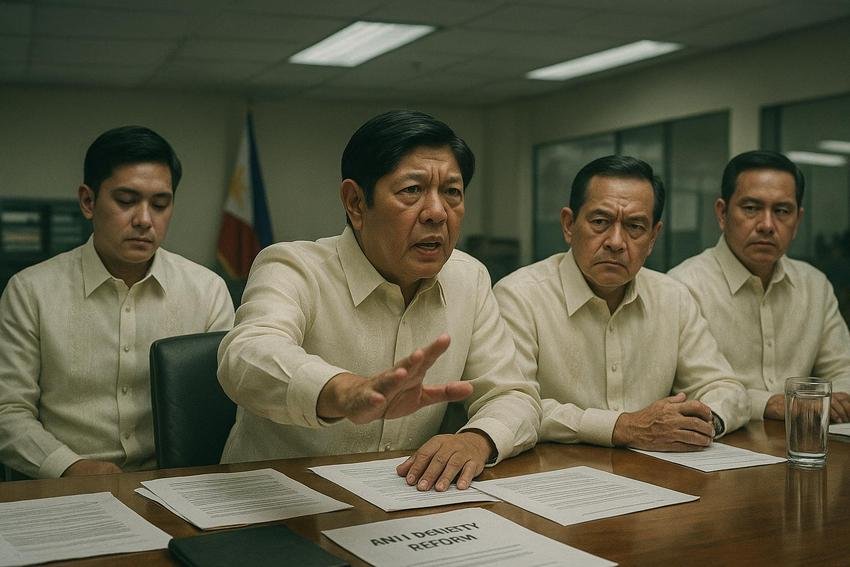
MANILA, Philippines — In a move that signals growing concern within Malacañang over persistent political abuses, President Ferdinand “Bongbong” Marcos Jr. has urged Congress to expedite a set of four legislative reforms aimed at curbing dynasty-driven governance, tightening party-list qualifications, boosting fiscal transparency, and enhancing public oversight mechanisms. The push, formalized on December 9 during a high-level meeting with congressional leaders, marks the administration’s most concerted effort yet to tackle long-standing political distortions that critics say have hollowed out Philippine democracy.
Marcos Targets Entrenched Power Structures
“The President wants to let the people know that you have a choice—one based on merit, not just because you share the same surname,” Press Officer Claire Castro said in a statement summarizing the administration’s message to the Legislative Executive Development Advisory Council (LEDAC).
Marcos’ directive focuses on four proposed laws:
- Anti-Dynasty Bill: Seeks to implement the 1987 Constitution’s yet-unenforced ban on political dynasties by legally defining and restricting familial successions in public office.
- Independent People’s Commission Act: Establishes a politically autonomous body to monitor governance quality and recommend electoral and institutional reforms.
- Party-list System Reform Act: Tightens eligibility criteria for party-list groups to ensure that genuinely marginalized Filipinos—not proxy organizations or elites—occupy reserved Congressional seats.
- CADENA Act (Citizens’ Access and Disclosure of Expenditures for National Accountability): Mandates standardized publication of public expenditures to ensure uniform transparency in government financial disclosures.
The legislative appeal comes amid heightened public scrutiny following a multi-billion peso kickback scandal within the Department of Public Works and Highways (DPWH), which has roiled investor confidence and invited comparisons to earlier systemic corruption crises.
Context: A Nation Dominated by Dynasties
Despite constitutional provisions that prohibit political dynasties, nearly 80% of district representatives currently serving in the House hail from political families, according to 2024 data from investigative organizations. Efforts to pass enabling legislation have faltered repeatedly over the decades, often due to conflicts of interest among lawmakers themselves.
The President, who is himself heir to one of the country’s most enduring and controversial dynasties, faces skepticism that his push for reform may be more symbolic than structural. Some political observers say that only an ironclad commitment—such as certifying these bills as urgent—would mark a true turning point in the battle against dynastic overreach.
Urgency Meets Institutional Resistance
“Without certifying the bills as urgent, it sends a weaker message to Congress to hasten approval,” said Representative Leila de Lima, a leading voice in the opposition. The Philippine presidency can expedite legislation by issuing such certifications, thereby shortening deliberation periods and elevating a bill’s status above routine measures.
Dr. Froilan Calilung, a political science professor from the University of Santo Tomas, echoed this sentiment, describing the initiative as “long overdue” while emphasizing that any meaningful reform must be backed by executive determination. “If President Marcos is really serious in fighting corruption, he should certify these bills as urgent immediately,” Calilung said.
A Divided Legislative Landscape
While leaders such as Senate President Vicente Sotto III and House Speaker Faustino Dy III have vowed to review the bills closely, the political calculus inside the legislature remains complex. Many lawmakers have familial or political stakes in the status quo, raising doubts about Congress’ appetite for self-limiting legislation.
The December 9 LEDAC gathering included several prominent figures, notably House Majority Leader Sandro Marcos, the president’s son. Though no official dissent was voiced during the meeting, the road to passage is likely to be steep, particularly with an impending holiday recess beginning December 20 and sessions resuming on January 19, 2026.
Eyes on Transparency and Electoral Fairness
In recent years, debate over the party-list system has intensified, with mounting evidence that elite-backed groups have increasingly displaced intended beneficiaries — marginalized workers, Indigenous communities, and farmers — from Congressional slots. The proposed reforms would reevaluate accreditation standards and require verifiable credentials for minority advocacy.
Similarly, the proposed CADENA Act seeks to counter inconsistent financial disclosures through a centralized, publicly accessible platform where expenditures from all branches of government are reported in standardized formats.
“People need to know exactly where their taxes are going. This is foundational to rebuilding trust,” Castro said, referencing the ongoing fallout from the DPWH corruption scandal.
Civil Society Weighs In
Reaction from civil society groups has been mixed. While analysts agree that the proposed bills represent substantive steps toward reform, many caution that implementation and enforcement—not mere passage—will determine their real effects.
“Failure to pass these bills would solidify Marcos’ position as a lame-duck president,” said ACT Teachers Rep. Antonio Tinio, warning that rhetorical commitments without legislative teeth could fuel public cynicism.
Still, some progressive lawmakers have signaled openness to cooperation if the administration demonstrates authenticity in pursuing reform. The situation, as one observer put it, is “a test not just of Marcos’ priorities, but of the entire political system’s ability to self-correct.”
Looking Ahead
With the December legislative calendar drawing to a close and lawmakers preparing for the holiday recess, attention now turns to the resumption of Congressional sessions in January. Political analysts suggest that the early weeks of 2026 could be pivotal. Passage of even one of the four priority measures might indicate a shift in political currents; failure to advance any could confirm suspicions of performative reform.
For now, President Marcos has thrown down a political gauntlet—one that not only challenges entrenched political families but also demands tangible action from a legislature long resistant to real change. Whether that gauntlet is picked up with conviction or quietly sidestepped remains to be seen.