MANILA — The Philippine National Police (PNP) has launched a sweeping nationwide crackdown on illegal Philippine Offshore Gaming Operators (POGOs), executing thousands of operations in a bold move to dismantle a shadowy network of online gambling enterprises linked to human trafficking, cybercrime, and corruption. The law-enforcement blitz follows the passage of the Anti-POGO Act of 2025 (Republic Act No. 12312), a pivotal law that formally outlaws all offshore gaming operations in the country.
Nationwide Crackdown Signals Policy Shift
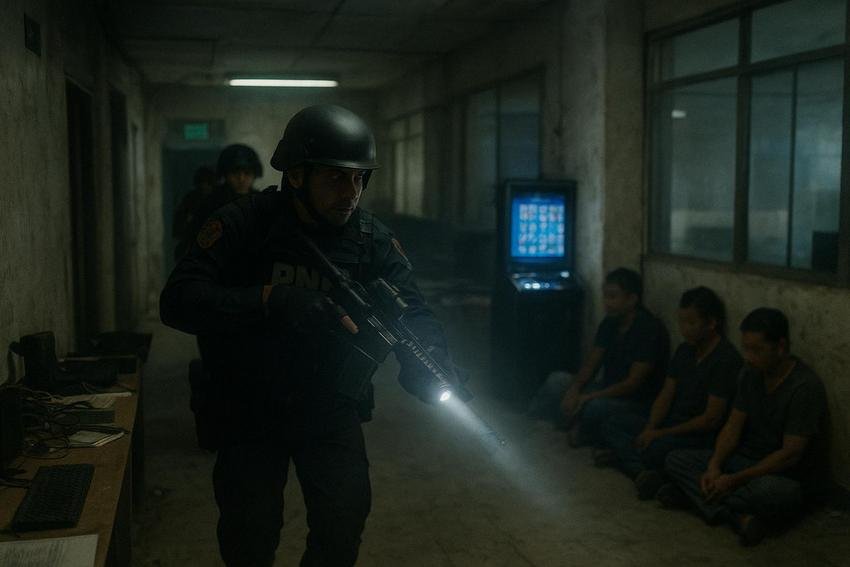
Unfolding across dozens of provinces, the intensified enforcement campaign has targeted both major compounds and covert POGO hubs operating behind the façade of business process outsourcing (BPO) firms. These efforts have borne fruit: over 7,500 high-value individuals have been arrested in more than 87,000 police operations, with hundreds of gaming sites shuttered and thousands of computers and telecommunications devices seized.
The campaign marks a decisive end to an industry long marred by controversy. While offshore gaming firms have contributed to employment and revenue, law enforcement officials argue that such economic gains cannot justify the extensive criminal ecosystem thriving beneath the surface.
Landmark Legislation Outlaws Offshore Gaming
President Ferdinand Marcos Jr. signed the Anti-POGO Act into law on October 23, 2025, issuing a firm decree that bans all forms of offshore gambling operations within Philippine territory. The law invalidates licenses issued by regulatory agencies including PAGCOR, TIEZA, and accredited ecozones, imposing stiff penalties aimed at breaking the commercial viability of the illegal POGO industry.
Under the new statute, offenders face 6 to 12 years in prison and can incur fines of up to ₱50 million. Foreign nationals involved in illegal gaming now face automatic deportation and permanent blacklisting from re-entry. Public officials found complicit in protecting or facilitating such operations will be dismissed and stripped of retirement benefits.
“At the stroke of midnight on New Year’s Day, it’s game over for Philippine offshore gaming operators,” government officials declared in a summary of their post-legislation enforcement directive.
“Island Cove” Compound Becomes Symbol of Cleanup
What began as a recreational resort in Cavite became ground zero for the country’s offshore gaming crackdown. On December 17, 2024, the PNP led a joint raid on what authorities described as the country’s largest POGO site — a sprawling compound with 57 buildings, housing an estimated 30,000 workers, half of whom were Filipinos. The site included dormitories, gambling hubs, and even shopping and dining amenities.
This high-profile closure served as a critical test case for enforcing Executive Order No. 74, signed in November 2024, which first directed law enforcement to dismantle illegal online gambling networks. The Island Cove example underscored the scale and organization of the underground industry and bolstered the case for legislative action.
Crimes Beyond Gambling: A Lattice of Illicit Activities
The motivations behind the POGO ban stretch far beyond opposition to gambling. Authorities say that many illegal operators are deeply entangled in organized crime. Investigations have uncovered links to human trafficking rings, cyber fraud operations, and even schemes involving the misuse of cryptocurrency platforms to launder billions of pesos in illicit funds.
One probe connected POGO-linked enterprises to a sprawling flood-control corruption scandal, suggesting that profits from offshore gambling were being funneled into bribe networks and public infrastructure rackets. “These are not isolated operations — they are enmeshed in a global criminal web,” law enforcement sources noted.
Inter-Agency Coordination Ramps Up
Central to the Philippine government’s campaign is the newly-established Administrative Oversight Committee (AOC), chaired by the Presidential Anti-Organized Crime Commission (PAOCC) and comprised of key departments including Justice, Interior and Local Government, and Information and Communications Technology.
This joint task force ensures that raids, asset seizures, deportations, and criminal prosecutions proceed in a synchronized manner. As part of the expanded legal toolkit, law enforcement agencies can now pursue civil forfeiture of POGO-related assets — including equipment, buildings, and financial proceeds — even in the absence of a criminal conviction, provided probable cause is established.
Public Officials and Foreign Nationals in the Crosshairs
The crackdown has exposed vulnerabilities in local governance. The PNP confirmed that corruption among municipal and provincial officials had previously allowed illegal gaming centers to operate despite warnings. Under the Anti-POGO Act, such officials now risk summary dismissal and loss of benefits.
Foreign nationals found complicit face a harsh triad of punishments: jail time, deportation, and lifetime bans from re-entering the country. Bureau of Immigration Commissioner Joel Anthony Viado underscored that the law is essential to securing national sovereignty. “We fully support the President’s leadership in putting an end to POGO operations,” he said. “This landmark law affirms our collective commitment to protecting our borders from criminal syndicates that exploit offshore gaming to engage in human trafficking, cybercrime, and other organized crime.”
Economic Fallout and Worker Transition
The government acknowledges the socioeconomic disruptions brought on by the POGO ban. Thousands of Filipino workers employed in customer service, IT, and administrative roles within offshore gaming firms now face displaced livelihoods. In response, the Department of Labor and Employment (DOLE) has begun rolling out a Labor Transition Program focused on upskilling and reemployment pathways.
Analysts note that while the immediate job losses are significant, the long-term benefits — including reduced crime rates, improved international reputation, and restored governance integrity — are likely to outweigh the short-term pain.
Expanding the Enforcement Frontier
With major hubs shuttered, the PNP is turning its focus toward what it calls “guerrilla POGOs” — makeshift, mobile operations that try to evade detection by masquerading as legitimate tech or BPO companies. These scattered outposts, often located in city high-rises and industrial parks, present a logistical challenge requiring sustained intelligence gathering and local government coordination.
Yet police officials remain resolute. “We are deploying every legal and operational tool to eliminate all vestiges of this criminal infrastructure,” said PNP Chief Gen. Rommel Francisco Marbil.
A National Reckoning and a Turning Point
From legislative halls in Manila to digital forensics labs deep in PNP headquarters, there is rising consensus: the era of offshore gaming in the Philippines is over. The Anti-POGO Act of 2025 is more than legal reform — it is a national reckoning, a sweeping effort to sever ties between governance and shadow economies.
As the crackdown evolves from rapid raids to strategic prosecutions and long-term rehabilitation of affected communities, the Philippine state is forging a new path forward — one where the rule of law is not optional, and short-term economic gains no longer justify long-term societal harm.