Spanish authorities on Tuesday confirmed that 45 people were killed in a devastating high-speed rail collision in southern Spain, bringing to a close days of recovery efforts at a crash site described by officials as a “mass of twisted metal.” More than 150 others were injured, dozens of them seriously, in one of the country’s deadliest rail disasters in more than a decade.
The crash occurred on Sunday evening near the town of Adamuz in Córdoba province, when two passenger trains travelling in opposite directions on the same line collided at around 7.45pm. The confirmation of the final death toll came after emergency crews recovered the last bodies from the wreckage and hospitals accounted for critically injured passengers.
A collision on a straight track
The accident involved a Malaga-to-Madrid train carrying 289 passengers and a Madrid-to-Huelva service with nearly 200 people on board. According to Spain’s transport ministry, the rear of the first train derailed on a straight section of track and struck the oncoming service, sending several carriages off the rails.
The impact was violent. The leading carriages of the Madrid-to-Huelva train were hurled down a slope of about 13 feet, bursting open and scattering debris across a wide area. Bodies were found hundreds of metres from the point of collision, underscoring the force unleashed when thousands of tonnes of steel met at speed.
Rescue amid twisted wreckage
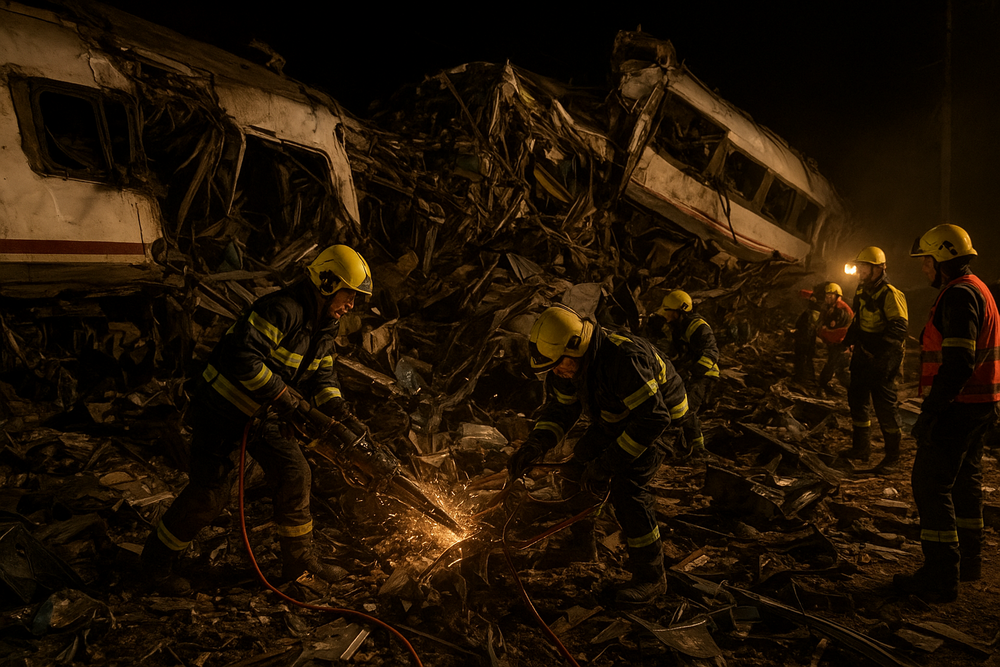
Emergency responders worked through the night, cutting through crushed metal to reach survivors trapped inside the carriages. By early Monday morning, all those still alive had been pulled free.
Of the more than 150 injured, officials said 41 people remained hospitalised, including 12 in intensive care, while many others had been treated and discharged. Hospitals across Andalusia activated emergency protocols to cope with the influx.
Describing the scene, Andalusia’s regional president, Juanma Moreno, said rescue teams were confronted with “a mass of twisted metal,” as the scale of the destruction became clear with daylight.
Officials baffled as investigation begins
Spain’s transport minister, Óscar Puente, said the worst of the casualties were concentrated in the front carriages of the Madrid-to-Huelva train, which bore the brunt of the collision. “The head of the second train took the brunt of the impact,” he said, adding that “the largest number of the deaths occurred in those carriages.”
What puzzled investigators most, Puente noted, was that neither train was believed to be speeding and the collision occurred on a straight stretch of track with standard signalling. Rail infrastructure manager Adif has launched a technical investigation alongside judicial authorities to determine whether human error, signalling failure or another malfunction was to blame.
Services between Madrid and Andalusia were suspended on Monday, causing widespread disruption and prompting questions about safety checks on one of Spain’s busiest rail corridors.
Echoes of a past tragedy
The disaster has revived painful memories of Spain’s 2013 Santiago de Compostela derailment, in which 79 people were killed after a high-speed train entered a curve at excessive speed. In that case, a court later found both the train driver and a senior rail safety official guilty of gross negligence.
While investigators have cautioned against drawing early conclusions, the comparison has fuelled public anxiety about whether lessons from that tragedy were fully learned.
National mourning
Spain’s royal family joined political leaders in expressing sympathy for the victims. King Felipe VI and Queen Letizia said they extended their “most heartfelt condolences to the relatives and loved ones of the dead,” and wished the injured a swift recovery.
As authorities closed the recovery phase and confirmed the final toll, flags were lowered across parts of Andalusia. For families waiting for answers, the end of the search offered little comfort—only the certainty of loss and the hope that the investigation will explain how a routine Sunday evening journey turned into one of Spain’s gravest modern rail disasters.